













![[2 Pack] Coospo Breathable Neck Gaiter Face Scarf Mask COOSPO](http://www.coospo.com/cdn/shop/files/106de7b046babc03aa610173af6e31aa_599da3fe-9907-4b1e-8eb0-f08b3032720b.png?v=1720591174&width=1600)


![[4 Pack] Coospo Soft Breathable Chilly Towel, Microfiber Towel COOSPO](http://www.coospo.com/cdn/shop/files/1_904094cc-62ee-40e9-aa21-415effb385b4.png?v=1720527561&width=1600)

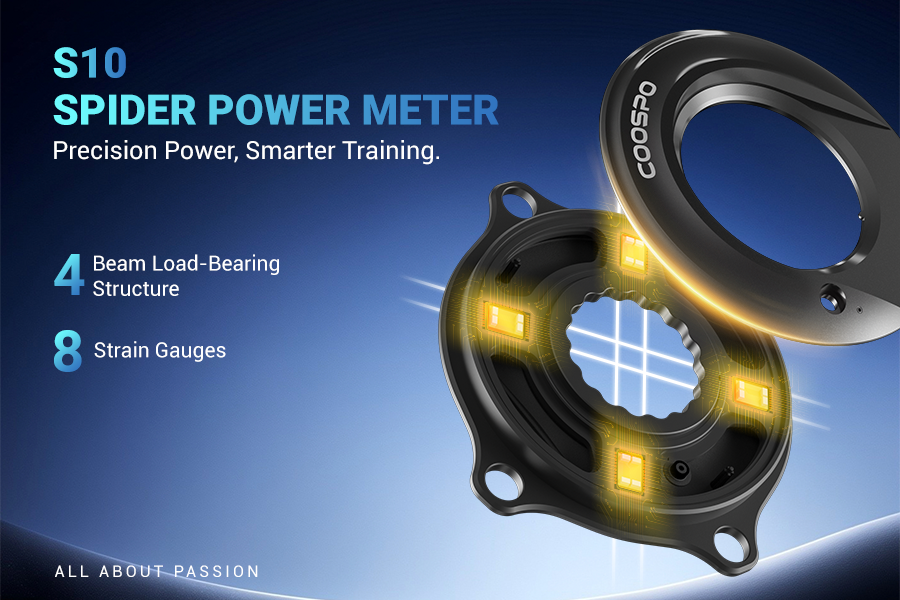
Les capteurs de puissance existent en plusieurs modèles, et les systèmes à plateau en étoile sont parmi les plus utilisés dans le cyclisme.
Contrairement aux capteurs de puissance intégrés aux pédales, qui mesurent la force exercée sur chaque pied, ou aux systèmes unilatéraux intégrés au pédalier qui estiment la puissance totale d'un seul côté, les capteurs de puissance intégrés à l'étoile du pédalier mesurent le couple au niveau de l'étoile, la partie centrale du pédalier. Ils mesurent donc la force de rotation totale appliquée au pédalier plutôt que la force exercée sur chaque jambe séparément.

En termes simples, il ne mesure pas directement la puissance de chaque jambe ; il mesure plutôt la force globale transmise à la transmission.
De ce fait, les systèmes à base d'araignées sont généralement reconnus pour leur bon équilibre entre précision, stabilité et rentabilité, ce qui explique leur utilisation encore répandue dans de nombreuses configurations modernes de capteurs de puissance axés sur la performance.
Tout d'abord, deux composants clés à l'intérieur d'un wattmètre Spider
Avant d'analyser en détail les systèmes basés sur des capteurs en forme d'araignée, il est important de comprendre ce qui permet réellement à un capteur de puissance de « ressentir » votre effort.
Qu'est-ce qu'une jauge de contrainte ?
Une jauge de contrainte est le « nerf sensoriel » d'un wattmètre.

Il s'agit d'un composant extrêmement petit mais très sensible, généralement fixé à des pièces comme le pédalier, l'étoile ou les pédales, partout où une force est appliquée.
Sa fonction est de détecter les infimes déformations du matériau causées par la force de pédalage.
Le principe est simple : une infime déformation entraîne une variation de résistance, ce qui provoque le calcul du couple et donc la production de puissance.
Autrement dit, chaque coup de pédale que vous effectuez est traduit en un signal électrique qui devient vos données de puissance.
Qu'est-ce qu'une structure porteuse (poutre) ?
Si les jauges de contrainte sont les « nerfs », alors la structure porteuse est le « squelette ».
Il s'agit d'une structure mécanique rigide conçue pour supporter la force et le couple de pédalage pendant le cyclisme.
Son rôle principal est de guider et de concentrer toute la force de pédalage dans un trajet mécanique contrôlé.
Sans cette structure, le capteur recevrait des signaux brouillés et les données ne seraient pas stables.
1. Noyau du wattmètre : la jauge de contrainte
Au cœur de chaque wattmètre se trouve un composant minuscule mais très important appelé jauge de contrainte.
Il fonctionne en détectant de très petites variations de la forme du métal lorsque vous pédalez.
Lorsque le métal se plie, même légèrement, sa résistance électrique change. Le capteur de puissance utilise ensuite cette variation pour calculer le couple et votre puissance de sortie en temps réel.
Les principes physiques fondamentaux qui sous-tendent ce phénomène peuvent s'écrire comme suit :
R = ρL/A
Lorsque le métal est étiré, sa résistance augmente.
Lorsqu'elle est comprimée, sa résistance diminue.
Lorsque vous appuyez (phase de puissance)
Lorsque vous appuyez sur les pédales, la structure du pédalier et de l'étoile s'étire légèrement.
Cela provoque :
- le métal à étirer
- la jauge de contrainte à déformer
- augmentation de la résistance électrique
- Un pédalage plus fort = un changement de signal plus important
- Puissance de sortie plus élevée affichée en temps réel
Plus vous forcez, plus vos données de puissance deviennent claires.
Lorsque vous remontez (Phase de récupération)
Lorsque votre pied remonte, le système entre dans une phase de non-alimentation.
Durant ce moment :
- la structure se détend
- la déformation de la jauge de contrainte diminue
- chutes de résistance
- La puissance de sortie chute rapidement à une valeur proche de zéro.
Il s'agit essentiellement de la phase « sans puissance » du coup de pédale, durant laquelle le système ne comptabilise pas la force active.
2. Structures porteuses (Conception des poutres)
La structure porteuse joue un rôle clé dans la stabilité d'un compteur d'énergie.
Cela influe directement sur la précision avec laquelle votre force de pédalage est captée.
Au fond, tous ces modèles tentent de résoudre le même problème : comment gérer la force de pédalage de manière stable et réduire les erreurs de mesure dues à la déformation.
▫️ Conception à poutre unique
Il s'agit de la structure la plus élémentaire.
Il n'utilise qu'une seule voie de force principale.
Points clés :
- La force n'est pas répartie uniformément.
- contrôle limité sur la déformation
- Les données peuvent fluctuer plus facilement
On le trouve généralement dans les configurations d'entrée de gamme ou les modèles conçus pour les petits budgets.
▫️ Conception à double faisceau
Il s'agit de la structure la plus courante et la plus répandue.
Elle divise la charge en deux chemins de force.
Principales améliorations :
- meilleure stabilité
- des données plus cohérentes
- bon équilibre entre coût et performance
Il est souvent considéré comme le « point idéal » pour l'entraînement régulier et les trajets domicile-travail.
▫️ Conception à quatre faisceaux (utilisée dans le capteur de puissance COOSPO S10 Spider)
Il s'agit d'une structure plus avancée et plus rigide.
Ses principaux avantages sont :
- La force est répartie sur plusieurs points.
- meilleure résistance aux interférences
- chemin de déformation plus contrôlé
- stabilité et précision accrues
Il est couramment utilisé dans les configurations d'entraînement haut de gamme et les systèmes axés sur la performance.
3. Structure en araignée du COOSPO S10
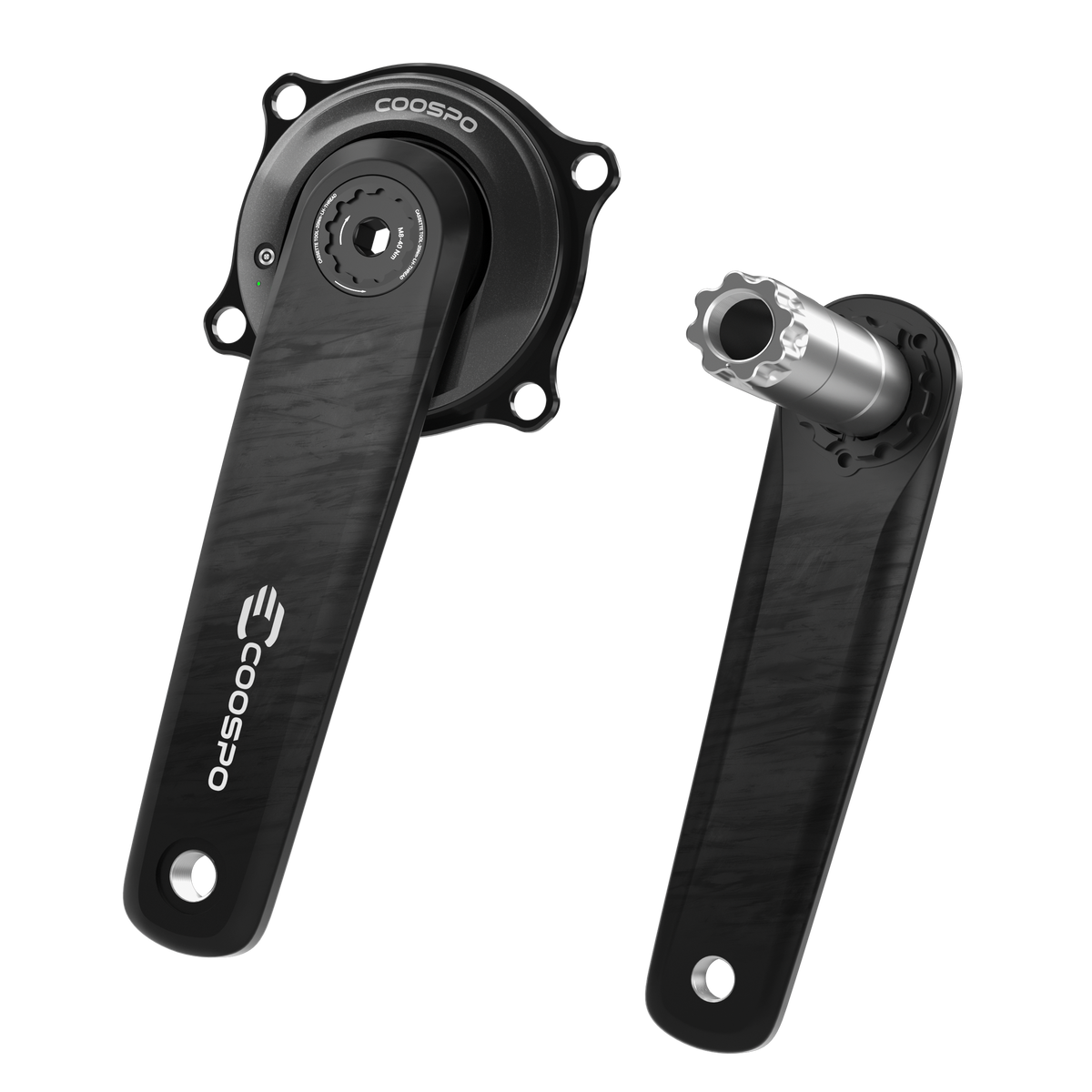
Le Capteur de puissance COOSPO S10 Spider utilise un structure à quatre poutres avec 8 jauges de contrainte, offrant une conception plus avancée au sein des systèmes de compteurs d'énergie à base d'araignée.

Sa logique structurelle est simple :
- quatre poutres porteuses disposées selon une configuration à symétrie croisée
- chaque poutre porte des jauges de contrainte des deux côtés
- ce qui permet à un total de 8 jauges de contrainte de fonctionner ensemble.
L'objectif de cette configuration est de :
- capter la force provenant de plusieurs directions simultanément
- annuler la dérive de température et les interférences externes
- amplifier les signaux utiles pour une résolution de mesure plus élevée
4. Principaux avantages de la structure COOSPO S10
La valeur d'un La structure à quatre poutres avec 8 jauges de contrainte ne se distingue pas seulement par sa complexité, mais aussi par la façon dont elle améliore la stabilité physique de la mesure de puissance.
Au fond, elle résout un problème clé : comment isoler la véritable puissance de pédalage dans des conditions de conduite réelles.
① Éliminer le bruit, ne conserver que le couple de pédalage réel
En pratique, les forces qui s'exercent sur le vélo sont bien plus complexes qu'il n'y paraît.
Les phases de pédalage en danseuse, les mouvements de balancement latéral, la flexion du cadre et la pression axiale font partie intégrante d'une pratique normale du vélo, mais ne sont pas toutes utiles pour la mesure de la puissance.
Ces forces sont considérées comme des « forces de bruit ».
Grâce à sa conception symétrique à quatre faisceaux, le système peut mieux gérer ces entrées indésirables :
- Les forces venant de directions différentes s'annulent mutuellement.
- Les charges non liées au couple sont absorbées par la structure.
- seul le véritable couple de rotation est mesuré
Il mesure la force que vous exercez réellement sur les pédales, et non le mouvement causé par le balancement du corps ou le mouvement du vélo.
② Forte stabilité thermique
Doté de 8 jauges de contrainte et d'une conception symétrique à quatre poutres, le système présente une résistance intégrée aux variations de température.
En conditions réelles de conduite, la température est en perpétuelle évolution :
- rouler par temps froid ou chaud
- le système chauffe lors des longs trajets
- changements rapides dans l'environnement
Dans de nombreux capteurs de puissance basiques, ces variations peuvent entraîner une « dérive », c'est-à-dire que la valeur de puissance devient progressivement moins précise.
Mais grâce à la conception du S10, la structure symétrique et la configuration en pont complet contribuent à compenser ces changements.
Ainsi, même lors de longues sorties, les données de puissance restent stables et cohérentes.
③ Résultat précis et cohérent
Grâce à sa conception structurelle équilibrée, le système peut réagir aux variations de force de manière très linéaire.
Cela signifie que la force que vous appliquez et la puissance que vous constatez restent étroitement corrélées.
Peu importe votre style de conduite :
- équitation d'endurance facile
- entraînement à tempo régulier
- efforts de sprint intenses
Le rendement reste très constant quelle que soit l'intensité.

En termes simples, la précision est suffisamment élevée pour un entraînement sérieux, avec une performance d'environ ±1 %.
④ Meilleure répartition de la charge, durabilité accrue
Les structures à poutres multiples ne se limitent pas à la précision ; elles améliorent également la durabilité à long terme.
- Conception à poutre unique → la force est concentrée en un point
- Conception à quatre poutres → la force est répartie plus uniformément
Cela conduit à :
- Une contrainte beaucoup plus faible sur un seul point
- réduction du risque de fatigue des métaux au fil du temps
- perte de précision de mesure plus lente avec une utilisation à long terme
En termes simples, lorsque la force est mieux répartie, le système dure plus longtemps et reste plus stable.
⑤ Mesure de couverture complète à 360°
La conception du S10 permet de capter la puissance tout au long de la course de la pédale.
Cela signifie:
- Même dans la « zone morte », le système conserve l'intégralité des données.
- Le couple maximal n'est pas manqué
- La puissance des jambes gauche et droite est enregistrée plus complètement
Elle offre une vision plus complète et réaliste de votre efficacité de pédalage sur l'ensemble de la rotation à 360°.
⑥ Haute qualité du signal, forte résistance aux interférences
Grâce à un circuit en pont complet et à plusieurs jauges de contrainte fonctionnant de concert, le système produit un signal plus net et plus stable.
Il peut réduire efficacement les interférences provenant de :
- vibrations de la route
- flexibilité du cadre
- bruit électrique
- petites fluctuations lors du cyclisme à faible cadence
Même à faible puissance, les données restent stables et faciles à lire.
Conclusion simple
Si vous recherchez des données de puissance cycliste stables, propres et très précises, Capteur de puissance COOSPO S10 Spider La conception est l'une des meilleures options disponibles dans les systèmes à base d'araignées d'aujourd'hui.


Laisser un commentaire
Ce site est protégé par hCaptcha, et la Politique de confidentialité et les Conditions de service de hCaptcha s’appliquent.