














![[2 Pack] Coospo Breathable Neck Gaiter Face Scarf Mask COOSPO](http://www.coospo.com/cdn/shop/files/106de7b046babc03aa610173af6e31aa_599da3fe-9907-4b1e-8eb0-f08b3032720b.png?v=1720591174&width=1600)


![[4 Pack] Coospo Soft Breathable Chilly Towel, Microfiber Towel COOSPO](http://www.coospo.com/cdn/shop/files/1_904094cc-62ee-40e9-aa21-415effb385b4.png?v=1720527561&width=1600)

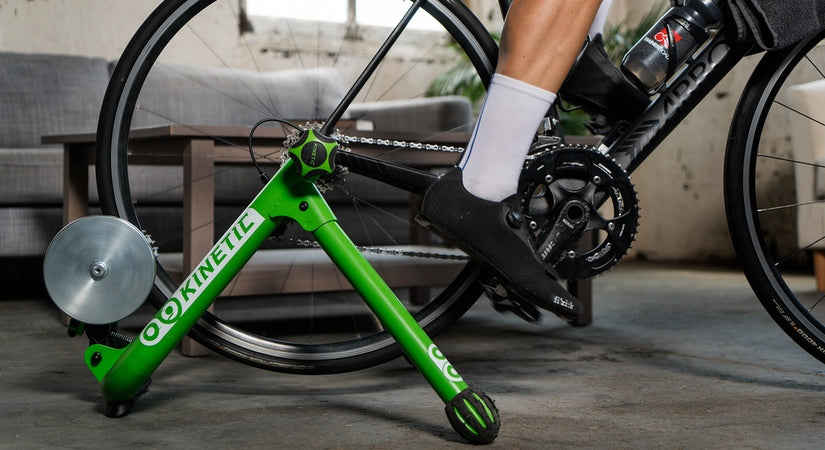
Indoor cycling used to feel like a compromise. Riders stared at basement walls, counted minutes instead of miles, and treated trainer sessions as punishment for bad weather. Smart trainers changed that completely. Today, indoor riding is no longer just an alternative to outdoor cycling. For many cyclists, triathletes, and fitness enthusiasts, it has become one of the most efficient and data-driven ways to train.
Modern smart trainers combine resistance technology, power measurement, and virtual cycling platforms to create an experience that feels remarkably close to riding outdoors. Whether climbing a virtual mountain in Zwift, completing a structured interval workout in TrainerRoad, or simply riding with friends from different countries, smart trainers have transformed indoor cycling into a connected ecosystem.
The appeal is easy to understand. Indoor training removes traffic, weather, stoplights, and unpredictability. What remains is pure riding and precise control over effort.
Top Reasons to Switch to a Smart Trainer
1. Ride Anywhere with Anyone
One of the biggest reasons cyclists move to smart trainers is connectivity. Indoor cycling is no longer a solitary activity hidden in a garage. Platforms like Zwift, TrainerRoad, and MyWhoosh have created virtual cycling worlds where riders can train, race, and socialize together in real time.

A rider in Toronto can join a group ride with cyclists from Spain, Japan, and Australia without leaving home. Training plans can sync automatically with smart trainers, adjusting resistance dynamically during workouts. The experience feels surprisingly immersive because resistance changes as the virtual terrain changes. When the road tilts upward on screen, your trainer physically becomes harder to pedal.
This social element matters more than many people expect. Exercise psychology research consistently shows that motivation and adherence improve when training includes community interaction and measurable progress. Virtual group rides and online races provide exactly that. Riders who previously struggled to stay consistent during winter often discover they ride more frequently indoors because the experience feels interactive rather than repetitive.
For parents, busy professionals, and riders living in harsh climates, the smart trainer becomes less of a backup option and more of a reliable training partner.
2. Realistic Riding Conditions
One reason early indoor trainers felt uninspiring was their artificial ride feel. Resistance was often inconsistent, and the sensation bore little resemblance to real-world cycling. Smart trainers changed that through sophisticated resistance systems and flywheel technology.
Today’s high-end trainers can simulate steep climbs, rolling terrain, descents, drafting effects, and even road surface changes. Some systems can reproduce gradients exceeding 20%, creating a realistic climbing sensation that forces riders to shift gears and adjust cadence naturally.
Many smart trainers also support ERG mode, one of the most influential developments in indoor cycling. In ERG mode, the trainer automatically adjusts resistance to maintain a target power output regardless of cadence or gearing. If a workout calls for 250 watts, the trainer continuously adapts to keep you at that exact effort.
Some advanced trainers now include movement systems that allow slight side-to-side sway or fore-aft motion. This reduces fatigue during long rides and mimics the natural movement of a bicycle outdoors.
Indoor cycling may never fully replace the feeling of descending a mountain road at sunset, but the gap between indoor and outdoor riding has become remarkably small.
3. Peak Performance
The strongest argument for smart trainers is performance improvement. Indoor training provides an environment of almost complete control. Every interval can be executed precisely. Every watt can be measured consistently. Every training session becomes repeatable and trackable.
This precision is why many professional cyclists and triathletes rely heavily on indoor training even during race season.
Power-based training has become central to modern endurance coaching. According to training methodologies developed by experts like Andrew Coggan and Hunter Allen, training with accurate power data allows athletes to target physiological systems much more effectively than heart rate or perceived effort alone.

Smart trainers often include highly accurate built-in power measurement, particularly direct-drive models (such as Coospo T10). This allows riders to train within specific power zones, monitor fatigue, and track fitness progression over time.
Smart Trainer Options
There are two main types of smart trainer on the market, wheel-on and direct drive:
1. Wheel-On
As the name suggests, wheel-on trainers work with your bike’s existing rear wheel and drivetrain. They secure to the frame at the rear dropouts and use a metal roller against the rear tire to transfer resistance between the bike and the trainer.
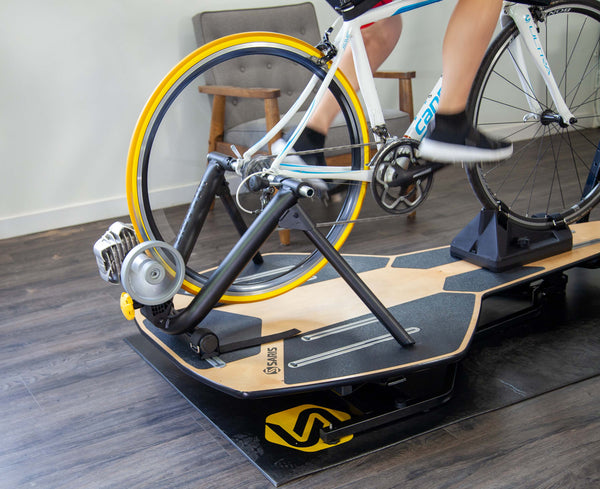
Some quick-release setups and all thru-axle bikes need adapters so the trainer can clamp securely to the dropouts. Since the rear tire presses against a metal roller, improper setup and calibration can lead to extra noise, heat buildup, and tire dust. A trainer-specific tire can help by lasting longer, slipping less, and producing less dust.
Moving your bike between indoor and outdoor setups really comes down to how quickly you can swap the rear tire, which is a major downside for many riders. On the plus side, wheel-on trainers are straightforward and durable, usually cost less, and are often lighter and easier to move around.
2. Direct Drive
Direct-drive trainers represent the premium category of indoor cycling. These systems require removing the rear wheel and mounting the bike directly onto the trainer’s cassette.

This direct connection produces several important benefits.
First, ride feel improves dramatically. Without tire slippage or roller friction, resistance becomes smoother and more realistic. Second, power measurement accuracy increases significantly, often reaching within ±1% on high-end models. Third, noise levels decrease substantially.
For apartment living or early-morning training, this quieter operation can make a major difference.
Direct-drive systems also handle higher power outputs and steeper gradient simulations, making them ideal for competitive cyclists and serious training programs.
The trade-off is cost. Direct-drive trainers are more expensive and slightly less convenient to set up. But for riders focused on long-term performance, the investment is often worthwhile.
Wheel-On vs. Direct Drive at a Glance
Wheel-On
Resistance is applied to your back wheel via a roller.
Pros - Typically starts at a lower pricepoint
- Can be lighter, and easier to move
- Less tech, simple and robust to use
Cons
- Louder during operation
- Require specialty tires for best performance
- Can require axle adapters specific to your bike
Direct Drive
These trainers attach directly to your bike drivetrain.
Pros - Quieter when in use
- Compatible with more bike out of the box
- Faster to set up, and swap back to road riding
Cons - Typically start at a higher pricepoint
- Can be heavier, and difficult to move


Leave a comment
This site is protected by hCaptcha and the hCaptcha Privacy Policy and Terms of Service apply.